Wednesday, March 5, 2025

School Placement: Troublemaker

 Hello bloggers! 

Today's topic I'm going to talk about one of the troublemakers that is apart of my classroom placement. 

I am placed in a kindergarten class, therefore schooling is new to all students that are within the class. It is an adjustment. But this certain child has his own set of problems, and struggles more than the others. 

For all of the classes I have attended I have seen a common theme in all of them. From what the teacher in the class has told me, this child has a difficult home life. His mother left him at a young age and moved to a different state. The boy is now living with his father, and the father's girlfriend. When the boy is at school, the teachers in the class are very lovey towards him, and want to provide a space for him to feel comfortable and loved. 

The first time that I was there, he was no feeling well. The teacher informed me that this child never acts like this and is always all over the place. The whole time I was there the child played on the couch and felt and the teacher gave him a blanket to cuddle with. 

The following week I was there, the child was acting completely different. He was all over the classroom, not able to sit still in his seat. During circle time, the Childs biggest problem is not talking. The child kept having to get reminded to stop talking. He would keep on repeating himself over and over. The child also always think she is right so when talking with other kids he will get upset with them for what they say. 

When completing on assignments a teacher always is making sure to sit with him, so he stays on task and completes his work. If not he will be up moving around, and shouting. During the class the student gets many reminders that he won't be able to go to recess if the work is not done, and if he is not acting appropriately. The teachers always make to give the student breaks, and they will take him for walks around the building to get moving. 

Lastly, the teacher informed me that the student has come a really far way. He used to throw fits and scream and throw the chairs. I have not seen this behavior from this student myself, which shows improvement. 

I believe this student has more work to improve on with his behavior. But the teachers in his class are there to help him succeed, and they are very caring for him. I think this is the best classroom for this student and they have his best interests in mind. 

I am looking forward to continuing to work with each of the students in my placement! I am learning a lot already:)

- Maci Maiello

Wednesday, February 26, 2025

Troublemakers: Introduction and Preface

 Hello blog readers! 

This week we had two short readings! 

In order to examine the idea of "troublemaking" as a form of resistance against oppressive school systems. The reading makes the case that by comprehending these children's viewpoints, educators can rethink education to place a higher priority on freedom and inclusivity than solid obedience.  The current school culture frequently makes students invisible by ignoring their different experiences and viewpoints because of things like gender, race, and class. 

One of the parts in the reading that stood out to me was, " I am calling on all educators- those in our classrooms, in our homes, and on the streets- to embrace and to respond to the urgency of our collective need to teach love and to learn freedom." It is interesting to see that teachers are more focused on achieving success with their students on a non educational level. Teaching life lessons is more important than pushing different kinds of ways to teach something like subtraction. For students that struggle with their home life or being raised, I think this is a visual thing to learn to live within society. 

Something relatable: 

In the reading it mentioned that young children energy and outlook can help change your imagination/how you are feeling. 

    With working in a daycare this stood out to me a lot. I believe that young kids do obtain that power. If I go into work in not the best of moods, but they have energy and are excited to learn and play, that energy rubs off and they teach you to let that bad mood go. 

- Maci Maiello 

Wednesday, February 19, 2025

The Academic and Social Value of Ethnic Studies Blog #5

Hello bloggers! 

    This week we had to read, The Academic and Social Value of Ethnic Studies by Christine Sleeter. This reading demonstrates the important academic and social advantages of ethnic studies programs, showing how these courses can improve students' academic performance, cultural awareness, critical thinking abilities, and social justice consciousness, especially for students of color by giving them a chance to learn about their own heritage and thinking about racial and ethnic issues in society. 

    Within a classroom this is very important. It will reduce stereotypes within a classroom, and it will provide positive relationships with other ethnic groups that also may be within the class. A strong sense of self and cultural pride can result from studying one's own culture and history within an Ethnic Studies framework. This can boost academic motivation and self-esteem. Based on studies, taking ethnic studies classes can enhance attendance, grades, and student engagement. Especially for students from underrepresented groups who frequently feel cut out from the traditional educational system.

    A personal connection relating to teaching about other ethnic groups is from my job at the preschool I work at. Each week there is a different theme that we focus on with the kids. One week we focused on learning about didn't ethnic groups. We did fun activities and read books on the different types of groups. We made sure to do all of the ones that were represented within our class. It was fun learning about them all, and the students enjoyed learning about them too! Everyone in the class got to learn about each other! I think it is important to start teaching about this to students from a young age, so they can start to become aware of it! 

Thank you for reading:)

Wednesday, February 12, 2025

The Four I's of Oppression


Welcome back blog readers! 

This week we watched a video about the Four I's of Oppression and what each one of those means for us!

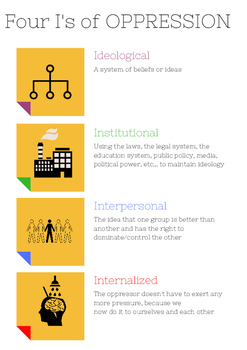
Here are the four of them: 

  • Ideological:
    This is the foundational level where beliefs about superiority and inferiority are established, often through cultural narratives and media portrayals. 

    Institutional:
  • This level refers to how institutions like government, education systems, and workplaces perpetuate inequalities through policies and practices that favor dominant groups.

    Interpersonal:
  • This involves everyday interactions where individuals from dominant groups may unknowingly perpetuate oppression through micro aggressions, biased language, or discriminatory behaviors. 

    Internalized:
  • This is when individuals from marginalized groups internalize negative stereotypes about themselves, leading to self-doubt and limiting beliefs. 

    Luna discusses her side of understanding by emphasizing the need of people analyzing their own deep biases and how they may unintentionally support restricting structures. She talks on how many oppressions (such as racism, sexism, and classism) reinforce and overlap with one another. 
    Knowing the "Four I's" is essential to actively eliminating oppressive structures by tackling problems at every stage, from structural changes to individual action. demonstrating how oppression affects members of marginalized populations directly and functions on many levels, ranging from cultural ideas to interactions with one another. 
    The 4 I's of Oppression: Ideological, Institutional, Interpersonal, and  Internal - Learning Library - Youth Power Hub

Wednesday, February 5, 2025

Other Peoples Children- Culture conflict in the classroom

 Hello bloggers, 

    This week I was able to read, "Other Peoples Children" by Lisa Delpit. This reading reveals the complex relationships between culture, power, and education, highlighting the firmly established but frequently unnoticed obstacles that keep minority children from succeeding in American classrooms. Delpit challenges us to reconsider what it means to teach and study in a truly equal setting by addressing the deep biases and beliefs in our educational system that support the dominant culture. serves as an important call to educators, legislators, and everyone else concerned with social justice to acknowledge and value the rich cultural diversity of every kid in our classrooms while also drawing light on the experiences and perspectives of students with disadvantages and their families. Delpit gives countless examples of teachers who believe that kids from lower-income families are stupid or disruptive when, in reality, they are only showing various ways of responding to and interacting with the content. Also, these children might not have learned the language at home as well as those from families with more money. After that, those students are ignored without ever having a fair chance.

    The main takeaway/message that I received from reading this was that students with disadvantages need to be taught how to thrive in the current social environment. With wanting to become an educator myself I believe that making sure you don't make assumptions and judge students off their background is important. Just because each of your students will be different doesn't mean that they deserve to be treated differently. Within a classroom setting a teachers job is to make all of your students succeed. Within my future classroom I think maintaining that mindset is very important. All students in a class have the right to be treated equally. I definitely found this story interesting to read, and also surprising. 

    Thank you for reading my blog #3, come back for the next one! 

- Maci Maiello 


Saturday, February 1, 2025

Privilege And The Power of S. C. W. A. A. M. P


Welcome back to my 2nd blog post! 

    This blog will be focused around the discussion of power, privilege, and difference. And also the acronym, S.C.W.A.A.M.P. Let get started!

    Allan Johnson shows us how to examine oppression and inequality critically without breaking down in regret or hopelessness in Privilege, Power, and Difference. He removes the blinders that prevent us from understanding how our privileges hurt other people in a gentle but strong manner. He highlights how various forms of oppression, such as racism, sexism, and classism, link together and encourages people to critically examine their own privilege and take action to bring down these systems. It also highlights that understanding privilege isn't about feeling guilty but instead about actively working towards social change by realizing how unearned advantages affect other people. 

    If you don't already known what this acronym stands for here it is: straightness, christianity, whiteness, American-ness, able-bodieness, maleness, and property ownership. Ideologies and the systematic development of some people's subjective opinions are the main issue. These concepts both are very similar in their main meaning. They both represent categories in which they believe people fit into. People get categorized. 

    It was interesting to learn more about each of these in depth, and get a better understanding of each of them. I hope you also enjoyed reading about it! Thanks for listening! Come back for blog #3!

- Maci Maiello 

Monday, January 27, 2025

Introducing Myself

 Hello blog readers!                                                                                                  January 27th, 2025

    Welcome to my blog page about FNED 246! I want to start out my first post on this page with introducing myself to you all! I am currently a freshman here at RIC. I grew up in Smithfield, and attended school there throughout my years. I have created many memories through the years, whether that be doing dance, hanging out with family and friends, or doing cheerleading at my high school. While I'm sad that part is all over, I am excited to be able to make even more memories here at RIC! 

    While being a full time student here, I am also am a preschool teacher assistant! I have been working there for almost a year now. I love teaching and making relationships with each of the students in my class! This job has helped me gain more knowledge on teaching, and how to handle a classroom. While my job is challenging, it is also very rewarding! 

    I spend a lot of my time hanging out with my family and friends. They are both very important in my life. Me and my family are very close, we are always getting together, seeing each other, and having fun together! Coming to RIC also provided me with the opportunity to meet/make more friends! It has definitely made coming here fun! 

    I am a commuter student, so I was nervous at first about making friends here on campus and being able to do more then just come to my classes and go home. So I ended up joining a sorority here on campus. Delta Phi Epsilon. I am so happy that I pushed myself to do this. I have made so many friends that I wouldn't have without this sorority. So far, I am having a lot of fun!

    Here at RIC, I am majoring in Elementary Education with a concentration in Special Education. I am excited to be in FNED this semester to learn more about education. I have wanted to be a teacher for many years now, since I was a kid playing teacher in my room. I am excited to finally be able to pursue it!     

    I hope you enjoyed reading this little blog post so you can get to know me a little more! There will be more blogs to come! Stay tuned :)

- Maci 

Last Blog :(

  Hello blog readers!       Sadly this is the last blog I will be completing for my FNED 246 class! During my time in this class throughout ...